How to Turn Your Drone Into a Metal Detector?

Updated: Jan 22
A Practical Guide to Drone Magnetometers for Ground Scanning, Archaeology, and Treasure Hunting
Using a drone as a metal detector may sound futuristic, but it’s already a reality. Thanks to modern UAV magnetometer systems, drones can now detect buried metal objects, archaeological structures, unexploded ordnance (UXO), and geological anomalies, quickly, safely, and with impressive accuracy.
In this article, we’ll explain how a drone becomes a metal detector, how magnetometers work, and introduce three professional systems that make drone-based metal detection possible.

Can a Drone Really Detect Metal?
Yes, but not in the way a traditional handheld metal detector works.
Drones do not transmit electromagnetic signals into the ground. Instead, they use magnetometers, highly sensitive sensors that measure disturbances in the Earth’s magnetic field. Ferrous metals such as iron, steel, cannons, pipelines, weapons, and shipwreck components create magnetic anomalies that can be detected from the air.
This makes drone magnetometers ideal for:
Archaeology and historical research
Treasure hunting and relic recovery
UXO and landmine detection
Infrastructure inspection (pipelines, cables)
Geological and environmental surveys
What Is a Drone Magnetometer?
A drone magnetometer is a scientific instrument mounted on or suspended beneath a UAV. It detects very small variations in magnetic fields caused by buried or submerged metal objects.
To achieve accurate results, these systems are usually:
Mounted on non-magnetic booms or suspension lines
Positioned away from the drone’s motors and electronics
Paired with GPS and mapping software for data visualization
System 1: FG Sensors 3-Axis Drone Magnetometer Kit

The FG Sensors 3-Axis Drone Magnetometer Kit is a professional, high-precision magnetic sensing system designed for users who require raw, high-quality magnetic data for detailed analysis. It is widely used in archaeology, geophysics, UXO surveys, and advanced drone-based ground scanning.
Unlike turnkey systems, this kit is built for users who want full control over data collection and post-processing, making it ideal for scientific and professional survey workflows.
Key Features
3-axis magnetic field measurement, capturing X, Y, and Z components for full spatial analysis
High-sensitivity fluxgate sensors with very low noise
Built-in GPS module for precise geolocation of every measurement
Onboard SD card data logging, ensuring reliable data capture during flight
Lightweight design suitable for drone mounting or suspension
Workflow: From Flight to Analysis
The FG Sensors 3-Axis Kit follows a straightforward and reliable workflow designed for professional field use.
Before the flight, the magnetometer sensor and data logger are mounted on the drone, typically suspended below the UAV to minimize magnetic interference from motors and electronics.Once powered on, the system begins recording automatically.

During the flight, the magnetometer continuously measures the magnetic field in all three axes. At the same time, the integrated GPS receiver tags every data point with accurate position and time information. All measurements are written directly to the onboard SD card, meaning no live data link is required to safely store survey results.
After the survey is complete, the SD card can be removed or the logger connected to a computer via USB. The recorded dataset includes:
Magnetic field values (3-axis)
GPS coordinates
Timestamps for each measurement
This approach ensures data integrity even during long or complex survey missions.
Integration with PolarWave Data
One of the major advantages of the FG Sensors 3-Axis Kit is its direct compatibility with PolarWave Data analysis software.
Once the logged data is imported into PolarWave Data, users can:
Analyze survey results in 2D and 3D
Visualize magnetic anomalies with advanced filtering tools
Overlay scan results onto Google Maps
Accurately geo-reference detected targets for follow-up investigation
This integration allows users to move seamlessly from raw magnetic measurements to professional-grade interpretation and mapping, making the FG Sensors kit a powerful option for detailed and repeatable drone surveys.
Best Use Cases
Archaeological and historical site surveys
Geophysical and environmental research
UXO and unexploded ordnance detection
High-resolution magnetic mapping
Professional drone ground-scanning projects
System 2: TreasureHunter3D DroneRover

The TreasureHunter3D DroneRover is one of the most advanced drone-mounted metal detector systems available today. It’s designed not just for hobby treasure hunters, but also for archaeologists, surveyors, and professionals who want to scan large areas efficiently without tedious manual flying.
Autopilot and Intelligent Scanning
One of the standout features of DroneRover is its autopilot scanning functionality. Instead of manually flying the drone over every grid line, you simply draw your survey area on a map inside the smartphone app, hit Start, and the drone will fly the scan pattern automatically while the system collects magnetic data in real time.

This autopilot mode is designed so that even inexperienced users can perform professional-grade surveys:
Mark your search area on the screen
Press GO
The drone then flies a pre-defined scanning pattern on its own
You watch the scan progress live on your phone or tablet
This makes the DroneRover system far easier to use than typical UAV magnetometer setups, which often require manual piloting and expert flight paths to collect data consistently.
Smartphone-Driven Mission Control
DroneRover integrates with a dedicated smartphone or tablet application (iOS and Android) that gives you full control over the mission:
Select the area to scan
Adjust flight altitude and speed
Change scan resolution and sensitivity
Monitor battery status
Abort missions if needed
View results in real time with 2D/3D visualization
This interface makes it easy to use while providing real-time feedback, as the drone scans, you see magnetic anomalies displayed on your map screen instantly.
Real-Time 2D & 3D Mapping with PolarWave Data Integration
One of the most powerful features of the TreasureHunter3D DroneRover is its real-time 2D and 3D data visualization, combined with the ability to automatically connect scan results to the PolarWave Data platform for deeper analysis.
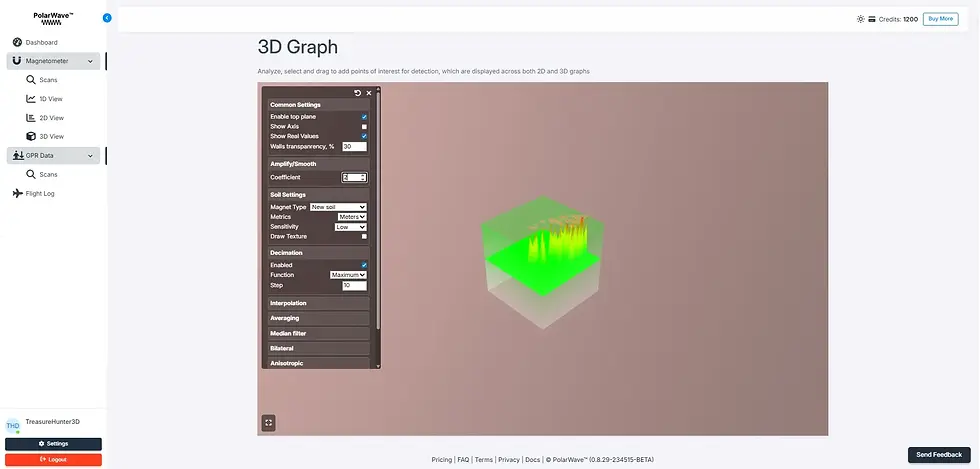
As the drone flies its autonomous mission, DroneRover collects magnetic data and displays live anomaly maps directly inside the DroneRover application. These maps allow users to instantly see areas of interest while still in the field, without waiting for post-processing.
What makes the system especially advanced is its direct data compatibility with PolarWave software.
After the flight, scan data can be automatically transferred and opened in PolarWave, where users can:
Perform advanced 2D and 3D data analysis
Refine anomaly visualization and depth interpretation
Compare multiple scans from different flights
Overlay magnetic data directly onto Google Maps
Precisely geo-reference targets for excavation or follow-up surveys

This seamless connection between DroneRover’s autonomous data collection and PolarWave’s professional analysis tools allows users to move from detection to interpretation without complicated conversions or manual data handling.
By combining real-time field visualization with advanced post-processing and Google Maps integration, DroneRover provides a complete workflow, from aerial scanning to actionable location data, making it an effective solution for treasure hunting, archaeology, UXO surveys, and professional ground scanning.
Other Practical Features
In addition to autopilot scanning, DroneRover includes:
A precise GPS system for accurate map alignment and survey repeatability (*When connected to a compatible drone)
Obstacle avoidance and safe flight sensors in autopilot mode, so the drone avoids trees and other objects automatically
Compatibility with a range of drones that can carry ~200 g, with DJI Phantom models often recommended for full functionality
DroneRover’s combination of autonomous scanning, live mapping, adjustable mission parameters, and intuitive app control makes it a powerful tool for surveys where speed, accuracy, and ease of use matter.

The PolarWave DroneRover Enterprise is a high-end, enterprise-grade drone magnetometer system designed for large-area surveys, advanced anomaly detection, and professional applications where speed, coverage, and data quality are critical.
Unlike single-sensor solutions, DroneRover Enterprise uses a five-sensor magnetometer array, allowing it to collect significantly more data per flight while maintaining high sensitivity and positional accuracy.
Key Features
Five synchronized magnetometer sensors for wide-area coverage
High-sensitivity magnetic field detection optimized for aerial surveys
RTK GPS positioning for centimeter-level geo-referenced accuracy
AutoPilot flight-planning application for easy mission setup
Onboard SD card data logging for reliable scan storage
Designed for autonomous and semi-autonomous drone operation

Workflow: From Autonomous Flight to Professional Analysis
DroneRover Enterprise is built around automation, precision, and data reliability, making large-area magnetic surveys efficient and repeatable.
Using the AutoPilot application, users can plan missions in just a few steps:
Define the survey area directly on an interactive map
Set flight altitude, line spacing, and scan direction
Automatically generate an optimized flight path
Launch the mission with minimal manual input
Once activated, the drone follows the planned route autonomously while maintaining consistent speed, altitude, and line spacing, critical factors for collecting high-quality magnetic data.
During the flight, magnetic field measurements are collected simultaneously from all five sensors. Each measurement is tagged with RTK-corrected GPS coordinates and securely stored on the onboard SD card, ensuring that the full scan dataset is preserved even in environments with limited or no data link.
The multi-sensor design enables:
Faster area coverage per flight
Uniform data density across the survey area
Improved depth estimation of buried objects
Reduced noise and false anomalies
After the mission is complete, the SD card contains a complete, geo-referenced dataset ready for analysis.
Integration with PolarWave Data
DroneRover Enterprise integrates seamlessly with PolarWave Data, a professional platform for magnetic survey interpretation.
Once the SD card data is imported into PolarWave Data, users can:
Visualize survey results in high-resolution 2D and 3D
Merge data from all five sensors into a unified anomaly model
Overlay magnetic maps directly onto Google Maps
Apply advanced filtering and comparison tools
Generate professional, geo-referenced reports for decision-making
This end-to-end workflow, from RTK-accurate autonomous flight to secure SD card data capture and advanced post-processing, makes DroneRover Enterprise a powerful solution for demanding professional applications.
Best Use Cases
UXO and landmine detection
Large-scale archaeological surveys
Infrastructure and pipeline inspection
Government and defense operations
Time-critical, high-coverage survey missions


Comments